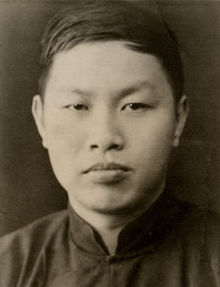
In 1920 at the age 17, Nee Shu-tsu was saved while being a high school student.
He would later testify about the experience saying, “From the evening I was saved, I began to live a new life, for the life of the eternal God had entered into me.”
When he felt the Lord call him into His work, he adopted the English name Watchman and the Chinese name To-sheng, which means “the sound of a watchman’s rattle.” Nee saw himself as a watchman raised up to sound out a warning call in the night.
Like A.W. Tozer, Charles Spurgeon, and G. Campbell Morgan, Watchman Nee was autodidact (self-taught). Nee didn’t attend theological schools or Bible institutes. His rich knowledge of God’s eternal purpose, Jesus Christ, the Holy Spirit, and the church were acquired through his intense study of Scripture, prayer, and reading the works of others. They also came from his experiences.
Nee was a student of Andrew Murray, Jean Guyon, John Bunyan, George Cutting, J.G. Bellett, Charles G. Trumbull, A.B. Simpson, T. Austin-Sparks, George Muller, Jessie Penn-Lewis, Mary McDonough, E.H. Broadbent, Robert Govett, and many others.
The core revelation Nee received involved the living of a crucified life and a resurrected life for the body of Christ and God’s eternal purpose.
He called living this life a normal Christian life.
Watchman Nee taught that believers have been crucified with Christ and that the normal Christian experience involves Christ living in us through our experience of bearing the cross in our practical human situations (Gal. 2:20).
Many of the experiences that informed Nee’s understanding of this truth are presented in his groundbreaking book, The Release of the Spirit.
Like Bonhoeffer, a contemporary of Nee’s, Watchman Nee saw that the church as the Body of Christ was simply the enlargement, expansion, and expression of the resurrected Christ.
Nee’s vision of the church as the Body of Christ in resurrection was advanced. His ministry concerning the crucified and resurrected Christ was a stewardship of grace that ministered the resurrected Christ into the believers for the building up of His Body.
His books The Glorious Church and The Normal Christian Church Life are classics.
Watchman Nee’s ministry was two-fold:
1) the deeper Christian life for all Christians about deepening the individual spiritual walk.
2) the life and practice of the church.
The first ministry of Nee’s is still popular today; the second is still controversial.
Nee wrote about his commission saying,
“What the Lord revealed to me was extremely clear: Before long He would raise up local churches in various parts of China. Whenever I closed my eyes, the vision of the birth of local churches appeared…
When the Lord called me to serve Him, the prime object was not for me to hold revival meetings so that people might hear more scriptural doctrines, nor for me to become a great evangelist. The Lord revealed to me that He wanted to build up local churches in other localities to manifest Himself, to bear testimony of unity on the ground of locality so that each saint might perform his duty in the church and live the church life. God wants not merely individual pursuit of victory or spirituality, but a corporate, glorious church presented to Himself.”
Nee suffered greatly due to his faithfulness, including rejection, opposition, slander, gossip, and condemnation.
But he was willing to pay the price for following the Lord, even to the point of the cost of his life. His profound revelation combined with his sufferings issued in a rich ministry of life.
Nee lived a life of suffering. The majority of his sufferings came from five sources: poverty, ill health, denominational opposition, dissenting brothers and sisters in the local churches, and imprisonment.
Nee was also frequently afflicted with serious illnesses, including tuberculosis and a chronic stomach disorder as well as angina pectoris, a serious heart ailment.
He was never cured of the heart disease; thus, his ministry was sustained by the resurrection life, not by his physical strength.
Like T. Austin-Sparks, his mentor, Nee was often criticized, slandered, and smeared by fellow “Christians.” He was also the frequent subject of false rumors, and the misrepresentations of his ministry were so strong that he once responded to them, saying, “The Watchman Nee portrayed by them I would also condemn.”
Following the takeover of China by the Communist party, Watchman Nee was arrested in 1952 for the sake of the gospel. He was falsely accused, condemned, judged, and sentenced to fifteen years’ imprisonment in 1956.
The story of Nee’s ending on this earth is tragic and heart-breaking. He died in confinement on May 30, 1972. He died in misery and humiliation. Not one relative or brother or sister in the Lord was with him. There was no proper notification of his death and no funeral. He was cremated on June 1, 1972.
Because Nee’s wife died six months earlier, her eldest sister was informed of Nee’s death and cremation. The following is a report from Watchman Nee’s grandniece, who accompanied Mrs. Nee’s sister to the labor farm to pick up his ashes:
“In June 1972, we got a notice from the labor farm that my granduncle had passed away. My eldest grandaunt and I rushed to the labor farm. But when we got there, we learned that he had already been cremated. We could only see his ashes. Before his departure, he left a piece of paper under his pillow, which had several lines of big words written in a shaking hand. He wanted to testify to the truth which he had even until his death, with his lifelong experience. That truth is—“Christ is the Son of God who died for the redemption of sinners and resurrected after three days. This is the greatest truth in the universe. I die because of my belief in Christ. Watchman Nee.” When the officer of the labor farm showed us this paper, I prayed that the Lord would let me quickly remember it by heart…”
In 1938, Nee traveled to Europe and delivered some amazing messages that were later published as The Normal Christian Life. It was then that he met T. Austin-Sparks.
Upon his return, Nee gave a conference on the Body of Christ. According to Nee, this was the second turn in his ministry. Nee recounted, “My first turn was to know Christ, and my second turn was to know His Body. To know Christ is only half of what the believers need. The believers also must know the Body of Christ. Christ is the head, and He is also the Body.”
In 1948, Nee trained workers.
Nee’s views were wholly orthodox. He believed in the verbal inspiration of the Bible and that the Bible is God’s Word. He also believed that God is triune, Father, Son, and Spirit, distinctly three, yet fully one, co-existing and coinhering each other from eternity to eternity.
He believed that Jesus Christ is the Son of God, even God Himself, incarnated as a man with both the human life and the divine life, that He died on the cross to accomplish redemption, that he rose bodily from the dead on the third day, that He ascended into heaven and was enthroned, crowned with glory, and made the Lord of all, and that He will return the second time to receive His followers, to save Israel, and to establish His millennial kingdom on the earth. He believed that every person who believes in Jesus Christ will be forgiven by God, washed by His redeeming blood, justified by faith, regenerated by the Holy Spirit, and saved by grace.
Such a believer is a child of God and a member of the Body of Christ. He also believed that the destiny of every believer is to be an integral part of the church, which is the Body of Christ and the house of God.
Nee shouldn’t be confused with Witness Lee who followed after him. Many who worked closely with Nee believe that Lee departed from Nee’s original vision and even his cautions.
Some of Nee’s best books
The Normal Christian Life
Sit Walk Stand
Changed Into His Likeness
Love Not the World
The Release of the Spirit
What Shall This Man Do?
The Character of God’s Workman
The Normal Christian Church Life
Against the Tide (The Biography of Watchman Nee)
Related Resources (Past and Present)

